What’s the difference between credible religious belief and superstition?
Rituals in sport For one sportsperson to be seen performing a religious ritual before or during a competition may seem very like another who insists on always walking three paces sideways before starting the same competition.
Talismans in war: the examples of miniature scriptures and lucky charms Similarly in WW1 the act of carrying a miniature Bible or Qur’an in the breast pocket of a military uniform may seem no different from continually carrying a ‘lucky charm’. Two items from the Imperial War Museum are telling examples of the question of the difference between religion and superstition. On the one hand there is a soldier's small Bible with black cover; bullet hole in bottom left corner of back, penetrating about one third of the way through the pages. It is reputed to have been in the left breast pocket of Gunner John Dickinson when hit in 1915 https://media.iwm.org.uk/ciim5/195/520/large_000000.jpg (catalogue number EPH 2024).
On the other, there is a piece of coal sent to WW1 soldier by his sister to bring him luck https://www.iwm.org.uk/collections/item/object/30084816 (catalogue number EPH 4894).


© IWM (EPH 2024)

© IWM (EPH 4894)
"I had to search the dead bodies for their little possessions. The doctor and I were amazed to find that nearly every man had a Bible or cross on him. They do seem religious, he said, these boys; I should never have thought they would have 'such things'. Perhaps they carried them as a charm, a sort of magic; perhaps because they felt more than they knew that 'such things' contained the secret of life and death and immortality; perhaps because they had a deep love for them. No one can say. "Committee on the War and Religious Outlook Religion among American Men (1920) p 89. Words of an American chaplain quoted in a retrospective report.
It is easy to conclude that religious belief is no more than illusion: https://www.youtube.com/watch?v=SRHIjBRHcNE.
Nails of patriotic sentiments 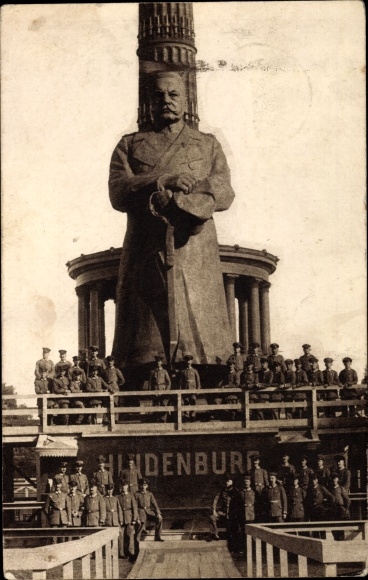 Field Marshall Paul von Hindenburg. As General Commander of the German Army he was a central figure in the public imagination. His statue in Berlin was a gathering point for expressions of national hope and nails of different metal values could be purchased for hammering. It would b
Susanne Brandt 'NAGELGIGUREN Nailing patriotism in German 1914-18' in Nichol Saunders Matters of Conflict: Material culture, Memory and the First World War (2004) chapter 5 pp 62-71.
Postcard 1915 of the Iron Hindenburg (nail figure) in Berlin (public domain)
Rosaries and crucifixes
"Catholics in this era had access to a much richer arsenal of protective supernatural resources, in the form of rosaries and holy medals. A German soldier tasked with burying the dead noted that most of the soldiers bore a medal of the Immaculate virgin. Devout Catholics wore the scapular, a pair of simple holy images worn over the chest and back and tied together with light woolen cloth over the shoulders. As scapulars were believed to give protection, from 1914 they became hugely popular among the soldiers and sailors of all the fighting nations. Whether French or German, Irish or Austrian, Catholic groups sent scapulars and holy images to the fighting forces, and anecdotal evidence suggests these were widely accepted, even by individuauls whose peacetime politics might have been strongly anti-religious. Protestants too developed a real affection for crucifixes and the protection they could afford." Philip Jenkins The Great and Holy War (2014) pp 123-4.
More than an illusion. But what if, instead of a miniature copy of Sacred Writings, a soldier is continually carrying the picture of a loved one. Some might do both. Others neither. In any such instances, much depends on the motives involved. Is it one which is believing that this action will guarantee safety and success? That could indeed be exposed as an illusion. That is very different from either or both of these items being a reminder of shared and fundamental affection and purpose in any testing ahead. Is it perhaps a bit of both? Would the absence of any such actions indicate mistaken self-sufficiency?
Prayer "The men of the British armies, however dim their faith may be, do in the hour of danger, at least, believe in God, 'the great and terrible God'. Most men we are told pray before they go over the parapet, or advance in the face of machine guns, and they thank God when they have come through the battle. It is possible to make too much and too little of this. Granting that it is at best a very elementary form of religion, and that it is usually evanescent enough, it is none the less very significant. It means that in presence of the most terrific display of material force that human history has ever seen men believe that there is an Unseen
Power, inaccessible to the senses, which is yet mightier than high explosives, which knows all and which hears prayer. No one who knows the history of religion can fail to see the importance even of so simple and
primitive an act of recognition of the Unseen as this. However brief and transient, it is an implicit repudiation
of that material view of life which is being judged in the thunder and flame around the men who pray." A comment which emerges in D S Cairns The Army and Religion: An Enquire and its bearing upon the Religous Life of the Nation (1919) pp 7-8 https://archive.org/stream/armyreligionenqu00lond/armyreligionenqu00lond_djvu.txt
A psychological perspective Alex Watson Self-deception and Survival: Mental Coping Strategies on the Western Front, 1914–18 http://ww1.ens.unibe.ch/Documents/Watson_2006_Self-deception_Survival_Coping_Strategies.pdf.